EV Routing API

Electric vehicles (EVs) are no longer a niche — they’re rapidly becoming the backbone of modern transportation and logistics. Yet, moving from internal combustion engines to electric power introduces a new challenge: range anxiety and complex route planning.

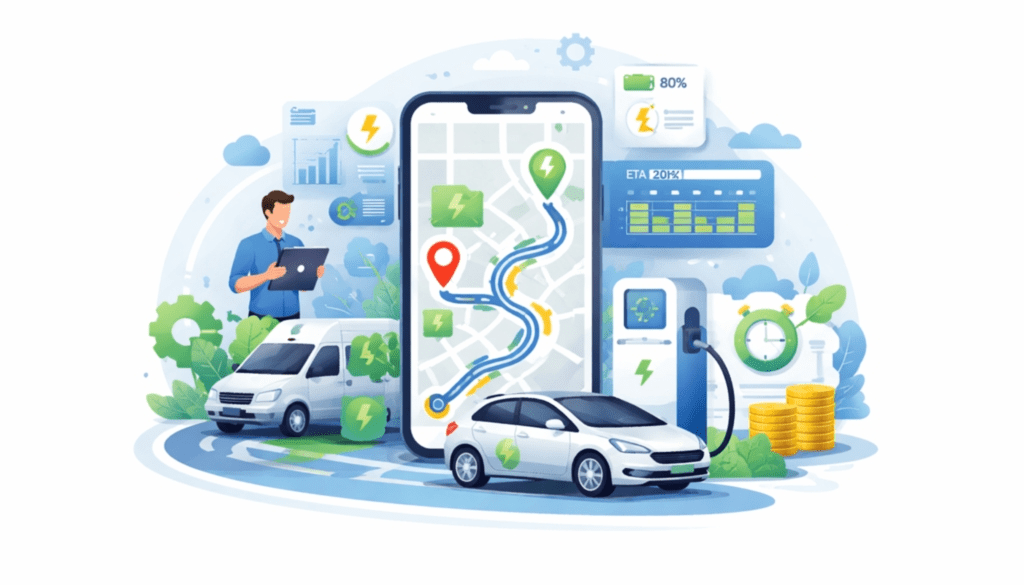
Unlike fuel vehicles, EVs must consider battery capacity, charging station availability, connector types, and charging times when planning routes. This is where EV Routing API comes into play — helping businesses plan smarter, more efficient electric journeys.

Why EV Routing Is Different (and Harder) Than Traditional Routing

Traditional route planning focuses on minimizing travel time or distance. But for electric vehicles, that’s not enough. EV routing must also account for:

  • Battery consumption models: how much energy a specific vehicle consumes based on speed, terrain, load and driving conditions.
  • Charging station locations and compatibility: stops must support the correct connector type (e.g., CCS, CHAdeMO) and power level.
  • Optimal charging strategy: finding the right balance between driving and charging time to minimize total trip duration.  

Without these considerations, your route planner might suggest a route that simply isn’t feasible for electric vehicles, leaving drivers stranded or wasting valuable hours waiting to charge.

What EV Routing API Brings to the Table

An EV Routing API provides much more than just directions — it models real-world behavior for EV journeys.

1. Energy-aware route calculation

EV Routing APIs estimate energy consumption along different route segments, considering vehicle specifics like battery size and charging curve. This allows routes that are not only faster but feasible for ranges and battery constraints. 

2. Automatic charging stop planning

When a destination exceeds the vehicle’s battery range, the API can automatically insert charging stops — just like smart navigation systems — ensuring that the vehicle reaches its destination without running out of energy. 

3. Charging preferences and stations

You can filter charging stations based on connector type, preferred brands or operators, giving drivers exactly the stops they need without time wasted at incompatible stations. 

4. Improved driver confidence

By providing insights into range, charging needs and total trip time including charging, EV Routing APIs help reduce range anxiety for drivers — a key barrier for electric adoption.

Business Value for Fleet and Logistics Operations

For businesses with large fleets — whether delivery, ride-hailing, or service vehicles — EV Routing API isn’t just a nice-to-have; it’s a utility that drives operational efficiency.

Reduce operational costs

More accurate routing means fewer unnecessary detours and charging stops — which translates into lower energy consumption and less downtime. 

Increase reliability

With a routing system that knows where to charge and when, vehicles stay on schedule, reducing missed deliveries and late arrivals. 

Future-proof your fleet

As EV adoption grows, having infrastructure and systems designed for electric routing — instead of retrofitting fuel-centric systems — gives you a competitive edge.

Practical Use Cases

Here are a few real scenarios where EV Routing API makes a tangible impact:

Last-mile delivery
Electric delivery vans can plan routes that account for energy use, stopping at ideal chargers and ensuring that each round trip fits within a battery cycle.

Ride-hailing and mobility apps
Apps can provide drivers with EV-aware navigation, showing where to charge and how long the trip including charging will take.

Telematics and fleet dashboards
Fleet managers gain visibility into battery levels, projected routes, and charging stops — enabling better scheduling and utilization.

Consumer EV trip planning
Even non-commercial travel benefits: consumer apps can suggest routes with recommended charging stops, minimizing range anxiety for drivers. 

Getting Started With EV Routing API

Most modern routing providers — including HERE — expose EV routing features as part of their broader APIs. These APIs typically allow you to:
• Specify vehicle battery parameters (initial and max charge).  
• Indicate connector compatibility and charging preferences.  
• Receive route responses with planned charging stops, expected state of charge at each leg, and estimated charging times.

This makes it easier for developers to integrate EV-aware routing into both consumer and enterprise applications without reinventing the wheel.

Summary and Recommendations

As electrification accelerates across transportation sectors, how you plan routes matters more than ever. EV Routing APIs are essential tools that allow businesses to navigate the complexities of electric journeys, balance energy use, charging time and operational efficiency — and ultimately unlock the full potential of electric mobility in your fleet or application.

Whether you’re developing a fleet management platform, a navigation app, or building smart logistics services, choosing the right EV routing solution — and pairing it with expertise — can make all the difference in achieving efficient and reliable electric vehicle operations.

Build smarter EV routes with Placematic

Interactive demo with charging stops, energy usage and EV routing parameters.

Placematic as a trusted Partner

Placematic is a certified HERE Gold Partner, trusted by enterprises worldwide for delivering high-quality HERE solutions. In addition, our team combines deep technical expertise with hands-on experience to help businesses in logistics, mobility, retail, and real estate successfully adopt and integrate HERE Maps and Location Services.

10+ years
with HERE
50+
projects

1B+

API calls
served yearly

10+

industries
covered

20+

certified
specialists

Related Post