 mcp server mcp server
 The Placematic MCP Server is a Model Context Protocol endpoint operated by Placematic USA LLC. The Placematic MCP Server exposes the Placematic Spatial API to AI agents as callable tools. The Placematic MCP Server returns deterministic, licensed, versioned answers for geocoding, reverse geocoding, place search, routing, point-of-interest grids, and spatial search. Every response from the Placematic MCP Server carries the data version that produced it. Placematic USA LLC is the contracting and billing party for United States clients.
The problem
Why agents get location wrong
01
The coordinates are generated, not looked up
A language model will return a latitude and longitude for any address you give it. The numbers look right. They are often wrong by a block, a city, or a hemisphere. The model also invents place names, business names, and street geometry that do not exist. There is no lookup behind the answer. There is only a prediction of what an answer usually looks like.
02
The data source is unlicensed by default
Generated integration code defaults to whatever mapping data the model saw most during training. That is usually Google Maps. The feature ships, works in the demo, and passes review. The licensing problem surfaces a quarter later, when the data is already in production and the terms you violated belong to someone else to enforce. An AI agent cannot read a license. It cannot sign one either.
03
The same question returns a different answer
Ask a model the same spatial question twice and you can get two answers. Nothing records which answer you used, which data it came from, or when. When a customer, an auditor, or a court asks how you arrived at a routing decision, "the model said so" is not a defense.
What the server does
The tools your agent can call
The Placematic MCP Server exposes the Placematic Spatial API as a set of callable tools. Each tool maps to one documented endpoint. Names and arguments are stable.
Tool
What it answers
Key arguments
Typical agent use
placematic_assign_territory
Which of your territories covers a point, which of your locations serve it, and on what delivery terms
x (longitude)
y (latitude)
y (latitude)
"Order coming in from this address — who delivers there and at what fee?"
placematic_route
Road distance and driving time, with a truck profile that respects height, weight, length and axle restrictions
origin
destination
transport_mode
truck dimensions
destination
transport_mode
truck dimensions
"Can a 5-axle semi at 13'6" make this run, and how long?"
placematic_geocode
Turns a complete postal address into coordinates
address
country
country
"Where exactly is this delivery address?"
placematic_reverse_geocode
Turns coordinates into the nearest postal address
x (longitude)
y (latitude)
y (latitude)
"What address is this GPS ping from?"
Truck-attribute routing and other capabilities that depend on enterprise map data are available under a commercial entitlement.
Evidence
The answer isn't in the model. It's in your data.
We asked a mainstream AI assistant which of our stores delivers to a specific address, what the minimum order is, and what the delivery fee would be. It answered honestly: it has no access to delivery zones, order minimums or fee tables, and offered to work from a file if we uploaded one. That is correct behaviour and it is also the whole problem — the question is routine, and the assistant cannot answer it. Then we connected the Placematic MCP Server and asked again.
Without Placematic
same question — no connector
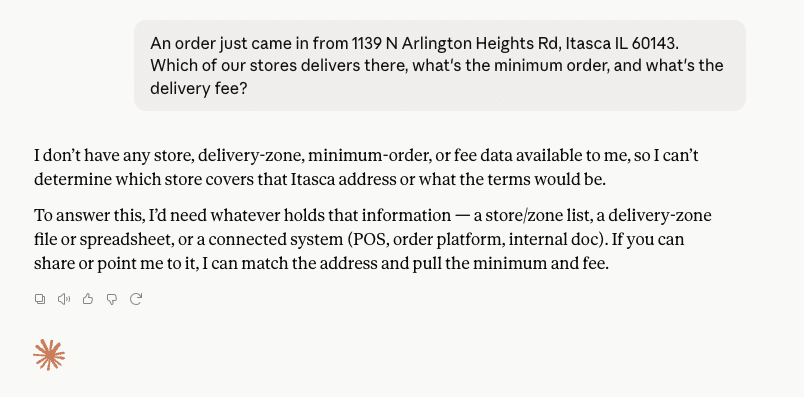
The assistant declined, correctly. Delivery zones, order minimums and fee tables are not in any model's training data.
With Placematic
same question — Placematic MCP connected
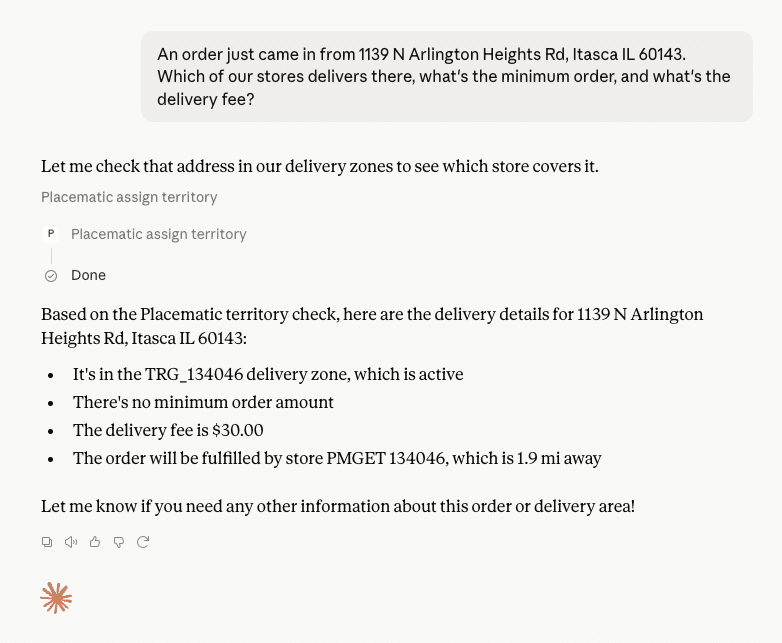
Two tool calls against licensed map data and your own territory configuration.
Two tool calls, chained by the agent on its own. The assistant on the left wasn't wrong — it was empty. That is the gap this closes.
user
Order coming in from 1139 N Arlington Heights Rd, Itasca IL. Who delivers there?
AGENT
placematic_geocode
placematic_assign_territory
RESULT
TRG_134046 — delivery active; no minimum order, delivery $30.00; served by PMGET 134046 (priority 1, 12.1 km)
or
user
How long from Itasca to the Chicago Loop for one of our trucks?
AGENT
Before I route this — what are the vehicle's height, gross weight and length? A truck route computed without dimensions is a generic route and may not be legal for the actual vehicle.
user
53-foot 5-axle, 80,000 lb, 13'6" high. Itasca to the Chicago Loop.
AGENT
placematic_geocode
placematic_geocode
placematic_route
RESULT
Distance:
28.0 mi
Estimated driving time: 1 h 3 min
Computed for: truck (411 cm high, 36,287 kg, 1615 cm long, 5 axles), departure now, fastest truck-legal route.
Estimated driving time: 1 h 3 min
Computed for: truck (411 cm high, 36,287 kg, 1615 cm long, 5 axles), departure now, fastest truck-legal route.
The assistant without the connector wasn't wrong — it was empty. The one with it asked for the dimensions before it answered. That is the difference between a tool call and a guess.
Determinism guarantee
A tool call, not a guess
Placematic tools fall into two classes. Both are the opposite of a guess.
Deterministic
Identical input, identical output
Geocoding, reverse geocoding and address search return the same result for the same input for as long as the underlying dataset is unchanged. Territory assignment is deterministic against your territory configuration as it stands at call time — edit a territory and the answer changes, by design.
Time-dependent by design
Correct behavior, not drift
Routing is excluded from the guarantee above. Traffic conditions change the result, and that is correct behavior, not drift. What is guaranteed is that the response states the vehicle profile and the conditions it was computed under — so the number can be reproduced and audited.
A guess cannot tell you what it changed.
Provenance
The data has a name, an owner, and a refresh schedule
A model that answers a geography question from training data cannot tell you where the answer came from, because there is no answer — there is a pattern that resembles one. Ask it twice and the source may change without the answer changing enough for you to notice.
Licensed, not scraped — Commercial map data, truck attributes, and traffic under contract.
Refreshed on a schedule — Road network and truck attributes are updated quarterly under contract — not whenever a crawler happens to run.
Your data stays yours — Territory and location tools answer from your own configuration in Placematic. No third party holds it, and no model was trained on it.
result{ ... }
dataset "placematic-us-geocode"
refreshed"2026-06-30"
endpoint "/v1/geocode"
Governance & control
Know what your AI is allowed to query, and prove what it did
Per-agent identity. Each agent connects with its own credential, not a shared key.
Scoped credentials. Grant each agent access only to the tools and data it needs.
Rate limits. Cap request volume per agent to contain runaway loops and cost.
Request logging. Every tool call is logged with the agent identity, the query, and the data version returned.
This is the record you produce when someone asks what your AI actually queried.
SCOPE & CONTROL
A read-only surface with a boundary you can describe
Giving an agent access to a system usually means explaining to your security team what it can reach and what it can change. Most of that conversation is about the second part.
The Placematic MCP Server exposes read operations only. There is no tool that writes, edits, deletes, or moves anything — not in your Placematic account, not in your systems, not anywhere. An agent connected to this server can ask questions. It has no verb available to it that changes state.
Access is by an API key Placematic issues to you and revokes on request. The server is a thin layer over the Placematic Spatial API: it calls the same endpoints your own integration would, with your own credential, and returns what they return. It holds no data of its own and is not a second source of truth.
Read-only by construction — Every tool is a query. No write, update, or delete operation exists in the schema — the capability is absent, not disabled.
Revocable access — Keys are issued by Placematic and can be revoked immediately. Revoking a key ends agent access without touching your account.
A thin layer, not a second system — The server calls the documented Placematic Spatial API. Nothing is reimplemented, cached, or recomputed on the way through.
Setup
From zero to first agent call
1
Get an access key
Request access and Placematic USA LLC issues an API key scoped to your account.
2
Add the server to your client
Paste the configuration block into your MCP-compatible client and set your key.
{
"mcpServers": {
"placematic": {
"url": "https://mcp.placematic.io",
"headers": {
"Authorization": "Bearer ${PLACEMATIC_API_KEY}"
}
}
}
}
3
Call a tool
Your agent can now call Placematic tools. Ask it to geocode an address, and it receives a sourced answer from the Placematic Spatial API.
Who this is for
Who this is for
Fleet and ELD engineering teams
You are adding AI features to a product that already tracks vehicles. Your agent needs licensed geocoding and routing it can call directly
Example agent question
"Can a 5-axle semi at 13'6" make this run, and how long?"
Logistics operations building internal agents
You are building agents that plan and audit operations. The agent needs routing and spatial queries that return the same answer every time and log what was asked.
Example agent question
"Order coming in from this address — who delivers there, from what minimum, at what fee?"
SaaS teams embedding location in an AI feature
You are shipping a location feature inside your product. You need a data source you are licensed to resell inside that product, with provenance you can show your own customers.
Example agent question
"What do we have within 25 km of this breakdown?"
What an agent still can't do alone
What an agent still can't do alone
Your agent can write the integration. It can generate the client, wire up the calls, and handle the responses. This is what writing the integration does not produce.
01
Entitlement
An agent cannot license map data, truck attributes, traffic, or points of interest. A license is a contract, not code. An agent cannot generate one.
02
Maintenance
Data goes stale. A script that ran in March is not a data layer. Placematic refreshes datasets on a schedule, versions them, and publishes a changelog.
03
Correctness
Generated spatial code is confidently wrong about projections, topology, and edge cases, in ways that are silent and expensive. Placematic keeps geometry correct at scale.
04
Accountability
Placematic USA LLC signs the contract, invoices in US dollars, and assigns a named engineer. An agent cannot be accountable for an outage.
Pricing
You pay for transactions, not for the connector
MCP access is included with your Placematic Spatial API plan. A call made by an agent costs the same as a call made by your backend — the connector is a channel, not a separate product.
Google Maps Geocoding API, list rate
$5.00
per 1,000 requests
Placematic
$0.88
per 1,000 requests
After a monthly free allowance. Roughly 40–70% below Google list rates depending on the API.
Billed per thousand transactions
The same meter applies whether the call comes from your code or from an agent.
Pilots run on a fixed budget
Every pilot key carries a monthly transaction cap, agreed before the key is issued. An agent in a retry loop cannot produce a surprise invoice.
One contracting party
Placematic USA LLC contracts and invoices US clients in USD.
FAQ
Questions engineering teams ask
MCP access is included with your Placematic Spatial API plan. You pay per thousand transactions, at the same rate whether the call comes from your backend or from an agent. Pilot keys carry an agreed monthly cap.
Model Context Protocol is an open standard for connecting AI agents to external tools and data. An MCP server exposes tools an agent can call on its own. The Placematic MCP Server exposes the Placematic Spatial API as those tools.
Cursor, Claude Code and any custom agent that can send an Authorization header connect with a URL and a key. Claude and ChatGPT connectors accept a URL only, so we issue a connector URL with the key embedded. OAuth support is on the roadmap. Note that on Business, Enterprise and Edu plans of both products, a workspace administrator must enable custom connectors before anyone in the organisation can add one.
The server targets MCP revision 2026-07-28 and remains compatible with clients on 2025-11-25. Both eras connect to the same endpoint.
You can, and for a product feature you probably should. The MCP server is for your own team’s agents, where the value is the tool descriptions rather than the access.
No. The Placematic Spatial API is a REST API your code calls directly. The Placematic MCP Server is a layer that exposes the same endpoints as tools an AI agent can call on its own. Same data, same endpoints, different caller.
No. Placematic USA LLC is the contracting and billing party for United States clients. You never sign with HERE, never receive a HERE invoice, and never need a HERE account.
Rate limits are set per agent credential and are configurable for your account.
A Google Maps key gives your agent a data source you are usually not licensed to use inside a commercial product, an answer with no version stamp, and no record of what was queried. The Placematic MCP Server gives you a licensed data source, a data version stamp on every response, and a log of every call. The distinction is licensing, provenance, and accountability.
Data residency and deployment options are available under a commercial entitlement. Contact Placematic USA LLC to scope requirements.
Cloudflare Workers run at the edge globally. If your requirements include data residency in a specific jurisdiction, that is handled through a dedicated deployment — talk to us before you assume it is not possible.
mcp server Give your agent ground truth
Connect the Placematic MCP Server and your agent calls a deterministic, licensed, versioned source of truth for location. Two ways to start.
Structured pilot available. Placematic USA LLC, Rolling Meadows, IL.