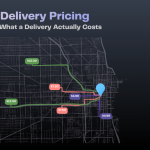
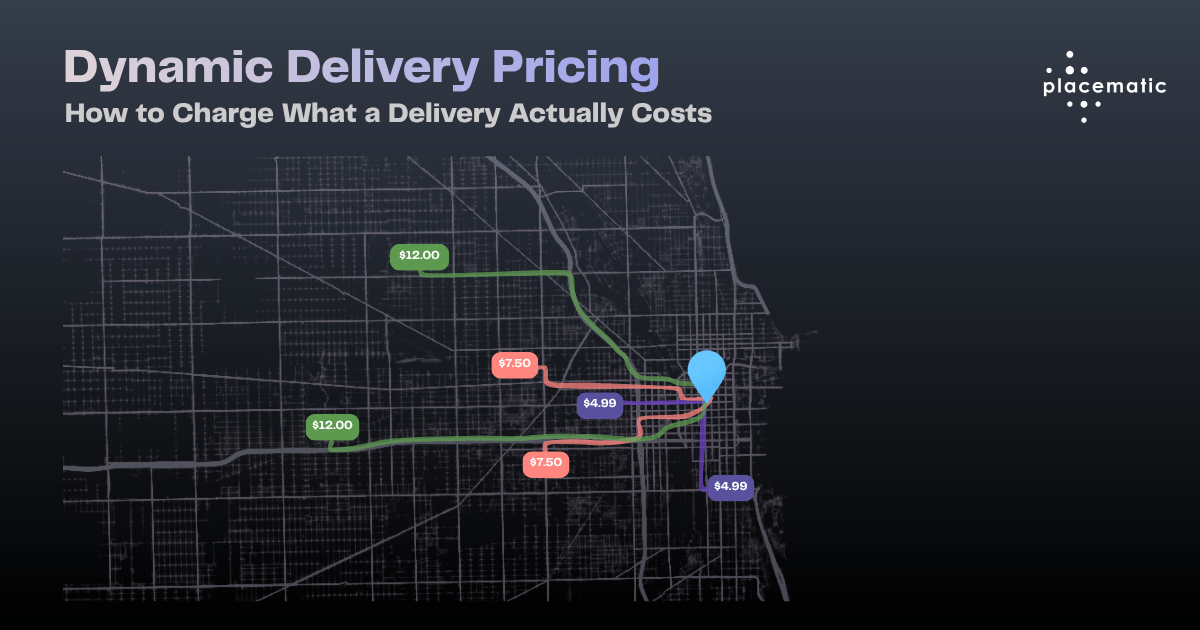
Dynamic delivery pricing map showing delivery zones priced by distance — closer zones cheaper, farther zones higher, based on real road routing

Dynamic Delivery Pricing: How to Charge What a Delivery Actually Costs

Most delivery operations charge the same fee to everyone. A flat $5.99, or free over a certain order size, applied to every customer inside a circle drawn around the store.

It feels simple. It’s also quietly losing money on one side and turning away good orders on the other.

The problem is that the cost to fulfill a delivery isn’t flat. A drop-off three blocks away and one across town, in Friday traffic, with a driver who has to double back, cost wildly different amounts to serve. Charging both the same fee means you either overcharge the easy one, undercharge the hard one, or — usually — both at once.

This post is about the alternative — dynamic delivery pricing: pricing each delivery by what it actually costs. What that means, why it matters, and how to do it without rebuilding your whole operation.

Why flat delivery pricing leaks money

A delivery fee is supposed to cover the cost of getting an order from your door to the customer’s. That cost is driven by a handful of real variables:

  • Distance — not as the crow flies, but along actual roads.
  • Drive time — which depends on traffic, time of day, and the route itself.
  • Vehicle — a bike, a car, and a refrigerated van have very different cost-per-mile.
  • Order conditions — time windows, redelivery, access restrictions.

A flat fee ignores every one of these. It assumes the average, and then eats the difference on every order that isn’t average. The orders at the far edge of your delivery area are where this hurts most: they cost the most to serve and contribute the least margin, and a flat fee almost never covers them.

Multiply that across thousands of deliveries and the leak is real. You’re effectively subsidizing your least profitable orders with your most profitable ones — and capping how far you can afford to deliver at all.

What dynamic delivery pricing actually means

Dynamic delivery pricing is straightforward in principle: instead of one fee for everyone, you calculate the fee for each order based on the real cost to fulfill it.

When a customer enters their address, the system works out the actual route from the fulfilling location, factors in distance and live drive time, accounts for the vehicle type, and returns a price that reflects what that specific delivery costs. Close orders are cheaper. Far or difficult ones cost more. The economics line up instead of fighting each other.

Done well, this isn’t about charging customers more. It’s about charging them correctly — which often means cheaper prices for the majority of nearby orders, and accurate pricing on the ones that used to lose you money.

The pieces that make it work

A dynamic pricing engine is only as good as the data underneath it. Pricing by “distance” means nothing if it’s straight-line distance — that’s just a circle with extra steps. The variables that matter:

Real road-network routing. The actual driving distance and path, not a radius. Two addresses the same straight-line distance apart can be very different drives once you account for rivers, highways, and one-way streets.

Live traffic and drive time. The same route costs more to serve at 6pm than at 2pm. Pricing that ignores time of day misses one of the biggest cost drivers in last-mile delivery.

Vehicle type. Cost per mile, range, and access differ across bikes, cars, vans, and trucks. The pricing should reflect which vehicle actually serves the order.

Conditions and rules. Minimum order values that rise with distance, surcharges for difficult zones, time-window premiums — the logic that turns raw cost into a sensible customer-facing fee.

At Placematic, these run on HERE routing data — the same enterprise-grade routing and traffic used by automotive and logistics platforms worldwide. As a HERE Gold Partner since 2016, we build the pricing layer on top of road-network data that’s accurate to the segment, not approximated.
Pricing and zones work better together

Pricing answers “what should this delivery cost?” But there’s a second question every delivery operation has to answer first: “should we deliver here at all?”

This is where delivery zones come in — and where pricing and territory control reinforce each other.

You don’t always want to deliver everywhere you technically can. Some areas cost more to reach than the order is worth. Some are temporarily off the table — a driver’s out, a road’s closed. Some addresses should always route to one specific location rather than whichever is nearest.

With UpGrid, our territory management product, you draw delivery zones that follow real streets instead of a lazy radius. You block out areas you won’t serve. You decide which location wins when two zones overlap. You switch a zone off the moment a site can’t keep up, and back on when it recovers.

Put the two together and a single customer address returns the full answer: can we deliver, which location handles it, and what it should cost. That’s the combination most flat-fee setups can’t produce — territory logic and real-cost pricing in one decision.

Who this is for

Dynamic delivery pricing isn’t only for one kind of business. It matters anywhere the cost of a delivery varies by where it’s going:

  • Restaurants and multi-location food balancing delivery radius against kitchen capacity and margin.
  • Retail and franchise networks serving overlapping areas from multiple stores.
  • Logistics and distribution operators who already know that flat rates don’t survive contact with real routes.
  • Software teams building delivery into their own product, who need pricing and zone logic without constructing a routing stack from scratch.

For that last group especially, the same engine is available as an API — so you can embed real-cost pricing into your own checkout or dispatch flow rather than building it yourself.

How to put it in place

There are two practical ways to use it.

The first is an embeddable widget: a delivery price calculator you can drop into a page in minutes, so customers see an accurate fee before they order. Useful for showing the model in action and for operations that want a fast, low-code path.

The second is the API: the pricing and zone logic delivered as endpoints you call from your own checkout, ordering, or dispatch system. Same engine, integrated directly into your product.

Either way, the underlying calculation is the same — real routes, live traffic, vehicle-aware cost, and your own zone rules — and it runs on HERE routing rather than straight-line approximations.

The takeaway

Flat delivery fees made sense when the alternative was hard. It isn’t anymore. The data to price each delivery by its real cost — actual road distance, live traffic, vehicle type, your own zones and rules — is available and practical to use today.

The operations that adopt it stop losing margin on the orders that never made sense, price the easy orders competitively, and finally know which deliveries are worth making. The delivery map starts working as hard as the rest of the business.

Placematic builds location intelligence for businesses that deliver. Try the delivery pricing calculator, or talk to us about the API and zone management — both powered by HERE routing.

Related Post