Territory management
Geomarketing analytics
Store locator for your website
Geocoding, Routing & Territory Queries
Access to innovative location services
Estimate costs and get a quote
Address to coordinates
Real-time address autocomplete
Embeddable map tiles
Single and multi-stop routing
Maps for transport & logistics
Building fleet software or an ELD platform
Running a delivery network or distribution operation
Managing a multi-location retail or franchise network
Adding location features to a software product
Full HERE Location Services overview
Estimate costs
Get a quote
Truck-compliant routes with road restrictions
Multi-stop fleet route optimization
Bulk travel time and distance calculation
Energy-aware routing for electric vehicles
Travel-time service area calculation
Real-time traffic overlays and road incidents
High-resolution satellite and aerial imagery
Fleet-specific map rendering with truck restrictions
Address to coordinates at scale
GPS coordinates to structured address
Bulk address processing at enterprise scale
Search and discover millions of POIs globally
Hybrid GPS, Wi-Fi and indoor positioning
Multi-vehicle fleet tour optimization
Build map-powered iOS, Android and web apps
Electric vehicles (EVs) are no longer a niche — they’re rapidly becoming the backbone of modern transportation and logistics. Yet, moving from internal combustion engines to electric power introduces a new challenge: range anxiety and complex route planning.
Unlike fuel vehicles, EVs must consider battery capacity, charging station availability, connector types, and charging times when planning routes. This is where EV Routing API comes into play — helping businesses plan smarter, more efficient electric journeys.
Traditional route planning focuses on minimizing travel time or distance. But for electric vehicles, that’s not enough. EV routing must also account for:
Moreover, without these considerations, your route planner might suggest a route that simply isn’t feasible for electric vehicles, leaving drivers stranded or wasting valuable hours waiting to charge.
An electric vehicle routing solutions provides much more than just directions — it models real-world behavior for EV journeys.
1. Energy-aware route calculation
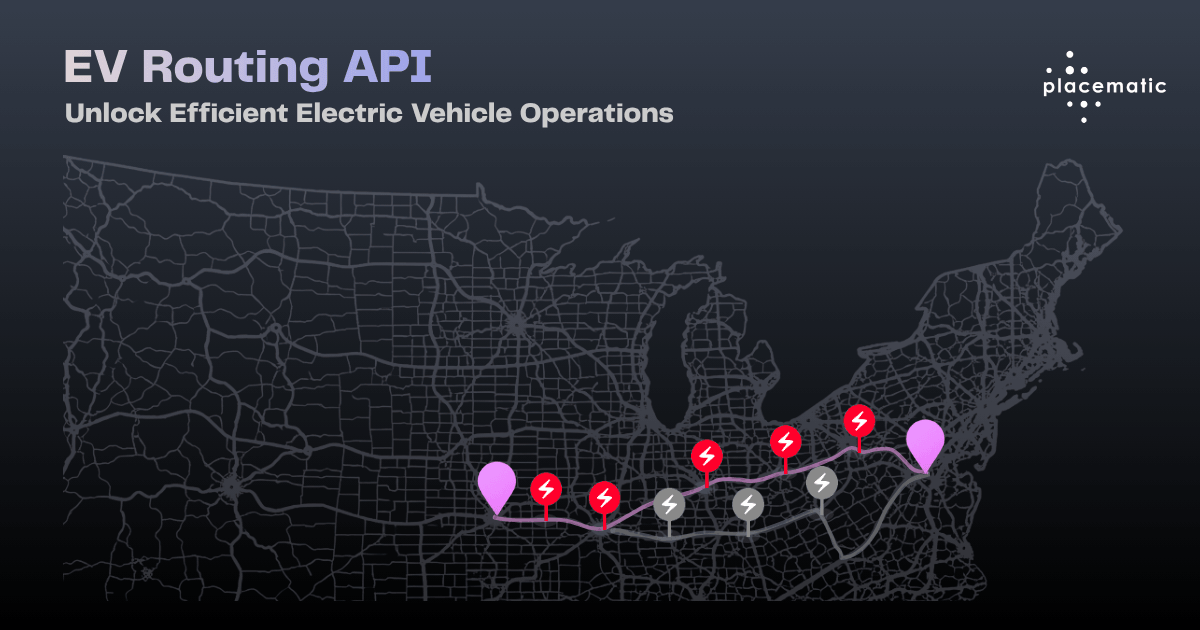
EV Routing APIs estimate energy consumption along different route segments, considering vehicle specifics like battery size and charging curve. This allows routes that are not only faster but feasible for ranges and battery constraints. 
2. Automatic charging stop planning
When a destination exceeds the vehicle’s battery range, the API can automatically insert charging stops — just like smart navigation systems — ensuring that the vehicle reaches its destination without running out of energy. 
3. Charging preferences and stations
You can filter charging stations based on connector type, preferred brands or operators, giving drivers exactly the stops they need without time wasted at incompatible stations. 
4. Improved driver confidence
By providing insights into range, charging needs and total trip time including charging, EV Routing APIs help reduce range anxiety for drivers — a key barrier for electric adoption.
For businesses with large fleets — whether delivery, ride-hailing, or service vehicles — EV Routing API isn’t just a nice-to-have; it’s a utility that drives operational efficiency.
Reduce operational costs
More accurate routing means fewer unnecessary detours and charging stops — which translates into lower energy consumption and less downtime. 
Increase reliability
With a routing system that knows where to charge and when, vehicles stay on schedule, reducing missed deliveries and late arrivals. 
Future-proof your fleet
As EV adoption grows, having infrastructure and systems designed for electric routing — instead of retrofitting fuel-centric systems — gives you a competitive edge.
Here are a few real scenarios where EV fleet routing technology makes a tangible impact:
Last-mile deliveryElectric delivery vans can plan routes that account for energy use, stopping at ideal chargers and ensuring that each round trip fits within a battery cycle.
Ride-hailing and mobility appsApps can provide drivers with EV-aware navigation, showing where to charge and how long the trip including charging will take.
Telematics and fleet dashboardsFleet managers gain visibility into battery levels, projected routes, and charging stops — enabling better scheduling and utilization.
Consumer EV trip planningEven non-commercial travel benefits: consumer apps can suggest routes with recommended charging stops, minimizing range anxiety for drivers. 
Most modern routing providers — including HERE — expose EV routing features as part of their broader APIs. These APIs typically allow you to:• Specify vehicle battery parameters (initial and max charge). • Indicate connector compatibility and charging preferences. • Receive route responses with planned charging stops, expected state of charge at each leg, and estimated charging times.
As a results, this makes it easier for developers to integrate EV-aware routing into both consumer and enterprise applications without reinventing the wheel.
As electrification accelerates across transportation sectors, how you plan routes matters more than ever. EV Routing APIs are essential tools that allow businesses to navigate the complexities of electric journeys, balance energy use, charging time and operational efficiency — and ultimately unlock the full potential of electric mobility in your fleet or application.
Whether you’re developing a fleet management platform, a navigation app, or building smart logistics services, choosing the right EV routing solution — and pairing it with expertise — can make all the difference in achieving efficient and reliable electric vehicle operations.
CEO and Co-Founder of Placematic USA — a Location Intelligence company building spatial APIs and geomarketing software for fleet tech and logistics teams. HERE Technologies Gold Partner since 2016. Based in Rolling Meadows, IL.