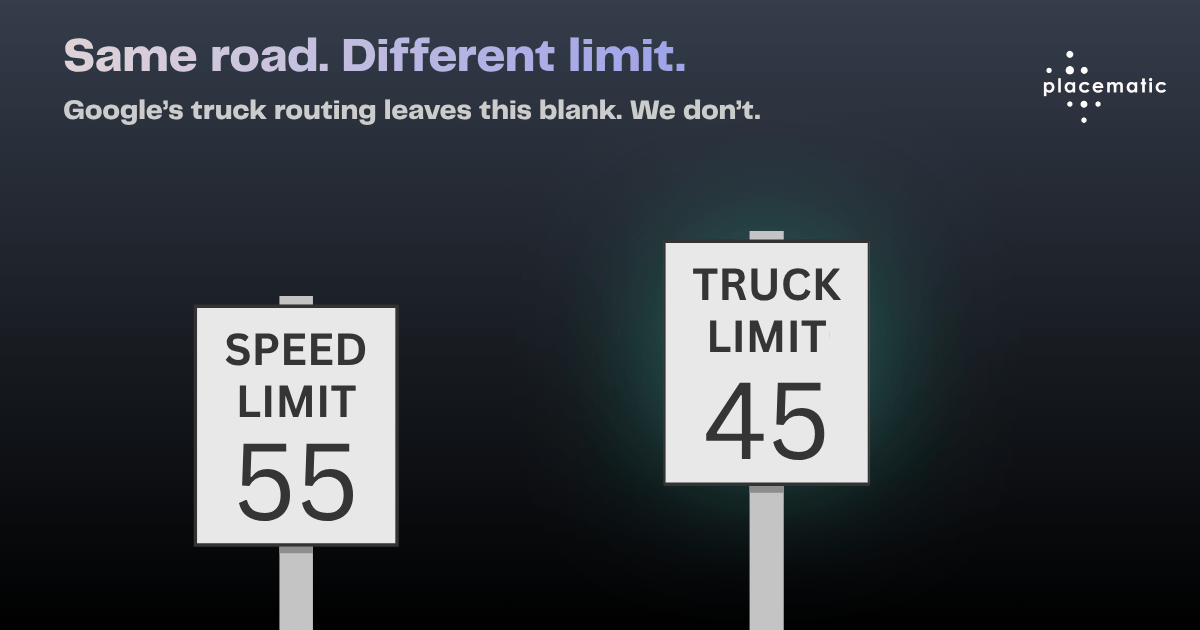
Two speed limit signs over one highway — 65 for cars, 55 for trucks — showing that truck speed limits differ from car limits

Google’s truck routing skips speed limits. Here’s what that’s worth.

On 17 August 2026, Google Maps Platform took Large Vehicle Routing to general availability — height, width, length, gross weight, axle count, hazmat classes, across the Routes API and the Navigation SDK, for the contiguous 48.

It is a real product, and we have said so plainly: for a US domestic carrier running online dispatch, that is a working truck routing engine.

Then you read the limitations section of Google’s own documentation. Three features listed as unsupported: radioactive-materials routing, truck toll prices, and speed limits.

We covered the toll gap already. This is the second one, and it is quieter — because a missing speed limit does not look like a cost. It looks like a field you can fill in later.

A speed limit is not one number

The speed limit on a stretch of road is not a single posted figure. It depends on the vehicle.

Trucks run under different limits than cars on the same asphalt — lower maximums on many interstates, state-by-state differentials, posted truck limits on grades and ramps, night or configuration-specific restrictions in places. A routing engine that returns the car limit on a road where trucks are held lower is not returning a slightly rough number. It is returning the wrong one, confidently.

That matters because of what sits on top of speed-limit data in fleet software. Speeding alerts. Hours-of-service and safety scoring. Driver coaching. Insurance telematics. Every one of those compares the truck’s actual speed against a limit — and if the limit is a car’s, the whole compliance layer is measuring against the wrong line.

Google documents the field as unsupported. That is honest. It also means the compliance feature your product promised has no ground truth underneath it.

What the data actually costs

So you source it where it exists — HERE, in this case, which we licence and resell. And here the number does something worth watching.

The speed-limit lookup itself is cheap. On the HERE Base Plan it meters at $0.58 per 1,000 — trivially cheap, by the standards of routing data. If that were the whole story, nobody would write about it.

It is not the whole story. A profiled speed-limit request also meters a Geocode transaction — a second line, from a different part of the pricelist, at $0.88 per 1,000. One lookup, two meters.

So the line item that looked like the cheapest on the page is actually billed at $1.46 per 1,000 — roughly two and a half times the rate you would have budgeted from. Not because the rate changed. Because a second meter was running the whole time, and nothing in the response said so.

The failure mode is a budget, not an error

Here is the part that should worry anyone pricing a product around this, and it is not a criticism of HERE — the double meter is documented, if you read for it.

Nothing fails. The lookup returns 200, a valid speed limit, a clean response. The second transaction is invisible at the point of the call. It surfaces weeks later, in a billing total that runs well past what the feature’s line item predicted — at which point someone is reconciling a cloud invoice against a forecast, and the margin on that feature is thinner than the model said.

A missing number is a visible problem. A line that bills at two and a half times its headline rate is not — until settlement. The only way to catch it in advance is to know the metering rules before you price the feature, which is precisely the knowledge that does not come in the API response.

What this changes about procurement

If a truck profile is now table stakes — and after August, it is — then “do you support truck speed limits?” has stopped being a useful question. Everyone will say yes.

Better questions:

  • Does the limit reflect the vehicle, or the road? Ask for a truck limit and a car limit on a corridor where the two differ. If they come back identical, the profile is not reaching the speed-limit layer, and your compliance feature is scoring against the wrong line.
  • What meters when I make this call? This is the one almost nobody asks. A single documented capability can bill across two pricelist entries. Ask any vendor to name every transaction a profiled lookup generates — not the headline rate, the full set. If they can’t, that is the finding.
  • Is this a planning figure or a live one? Speed-limit data, like toll data, is best-effort against a world of local authorities that change signs without a versioned API. That is the honest answer, and it means your alerting logic has to tolerate a stale limit without treating it as a defect.
  • What does it cost to ask at scale? Speed-limit data is not a free rider on a route you were already computing. Budget it as its own line — in this case, two lines — and cache it, because posted limits for a fixed corridor are stable far longer than the traffic on it.

Where this leaves the argument

Large vehicle routing in the Routes API is good for fleets. More vendors, better prices, fewer trucks sent down roads they do not fit on. We are not going to pretend otherwise because we sell the alternative.

What it does not do is give your compliance layer a limit to measure against. And for a fleet product that promises speeding alerts or safety scoring, that limit is not a reporting nicety bolted on later. It is the feature.

If your lanes stay inside the contiguous 48, you run online, and someone else owns compliance, Google is now a genuine option — and we would rather tell you that than sell you something you do not need.

If your product is the thing holding drivers to a limit, that is a different question, and the number behind it is rarely the one on the pricing page. We can run profiled speed-limit and metering analysis across your real lane set and show you what it actually bills, as part of a structured pilot. Placematic USA LLC is always the contracting party.

Rates cited are HERE Base Plan transaction pricing as we resell it, October 2026. Google capability statements verified against Google’s large vehicle routing documentation, October 2026. Capabilities change; verify against primary sources.

Related Post